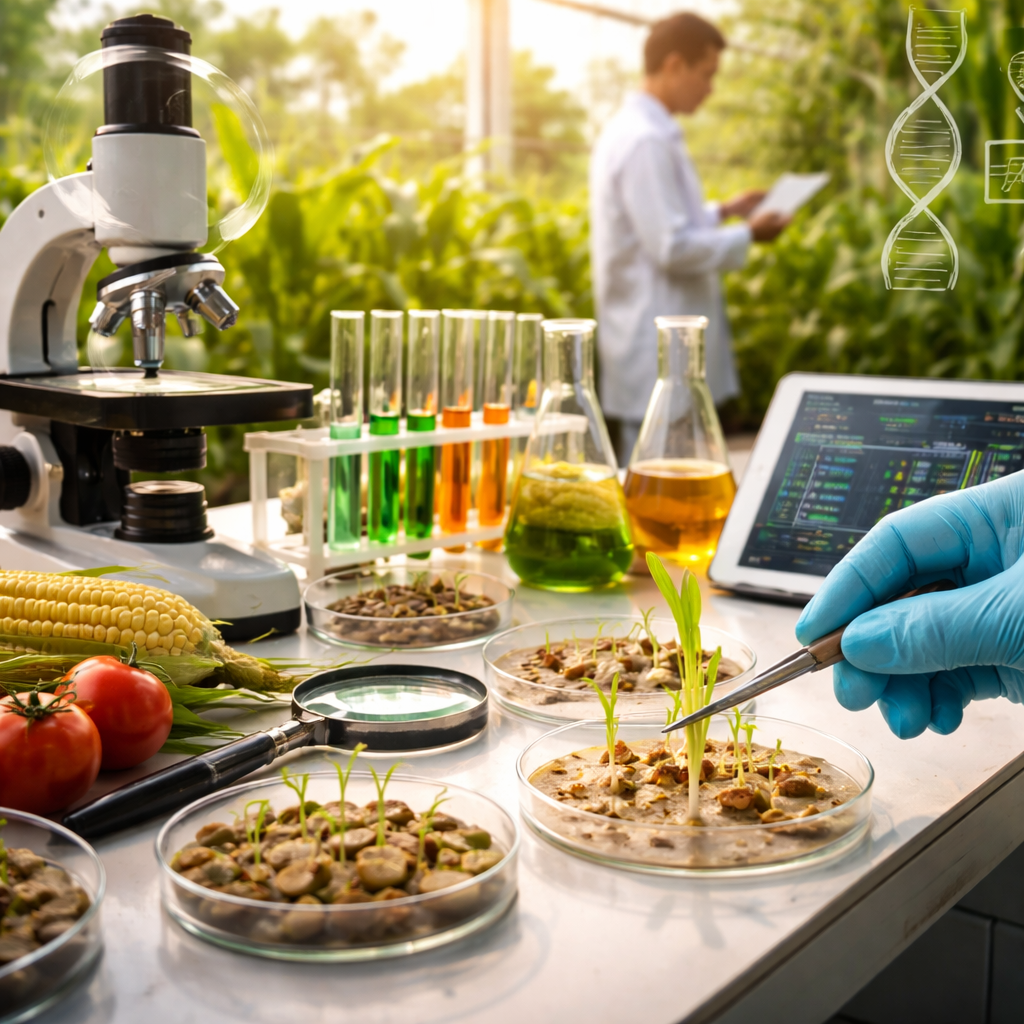
Agricultural Biology, located within Applied Life Sciences, is a domain focused on the biological principles and mechanisms that govern agricultural productivity, sustainability, and ecosystem health. It encompasses plant biology, animal science, soil–microbe interactions, pest and pathogen dynamics, crop genetics, and the physiology of domesticated species. The field integrates classical biological disciplines - such as botany, microbiology, genetics, and ecology - with applied sciences that support food production, resource management, and agricultural innovation. Research and practice in Agricultural Biology address crop improvement, disease resistance, nutrient cycling, soil fertility, livestock health, environmental stress adaptation, and sustainable farming systems. It further incorporates biotechnology, breeding strategies, and ecological management to enhance yield, resilience, and food security while minimizing environmental impacts. As a multidisciplinary domain, Agricultural Biology forms a critical interface between biological science, agricultural engineering, environmental stewardship, and global food systems.
Within the methodological structure of the Quantum Dictionary, Agricultural Biology exemplifies a domain where terminology is highly contextual, shaped by ecological conditions, technological interventions, species-specific biology, and regulatory frameworks. Concepts such as “resistance,” “productivity,” “fertility,” “stress,” or “adaptation” collapse into distinct semantic states depending on whether they are applied in crop genetics, soil science, livestock physiology, pest management, or agroecological modeling. Terminology also varies across agricultural systems—industrial, subsistence, organic, precision, or regenerative—each imposing different conceptual assumptions and operational criteria. The platform’s quantum-semantic architecture encodes each term as a contextual semantic entity whose meaning resolves according to biological scale, environmental parameters, methodological approach, or applied objective. This ensures semantic interoperability with adjacent fields including general biology, environmental science, veterinary science, chemistry, and biotechnology, while preserving the precision necessary for scientific research, policy development, and agricultural practice. By modeling the dynamic interactions among organisms, ecosystems, technologies, and human management, the Quantum Dictionary provides a coherent and adaptive lexicon aligned with the complexity and practical significance of Agricultural Biology.