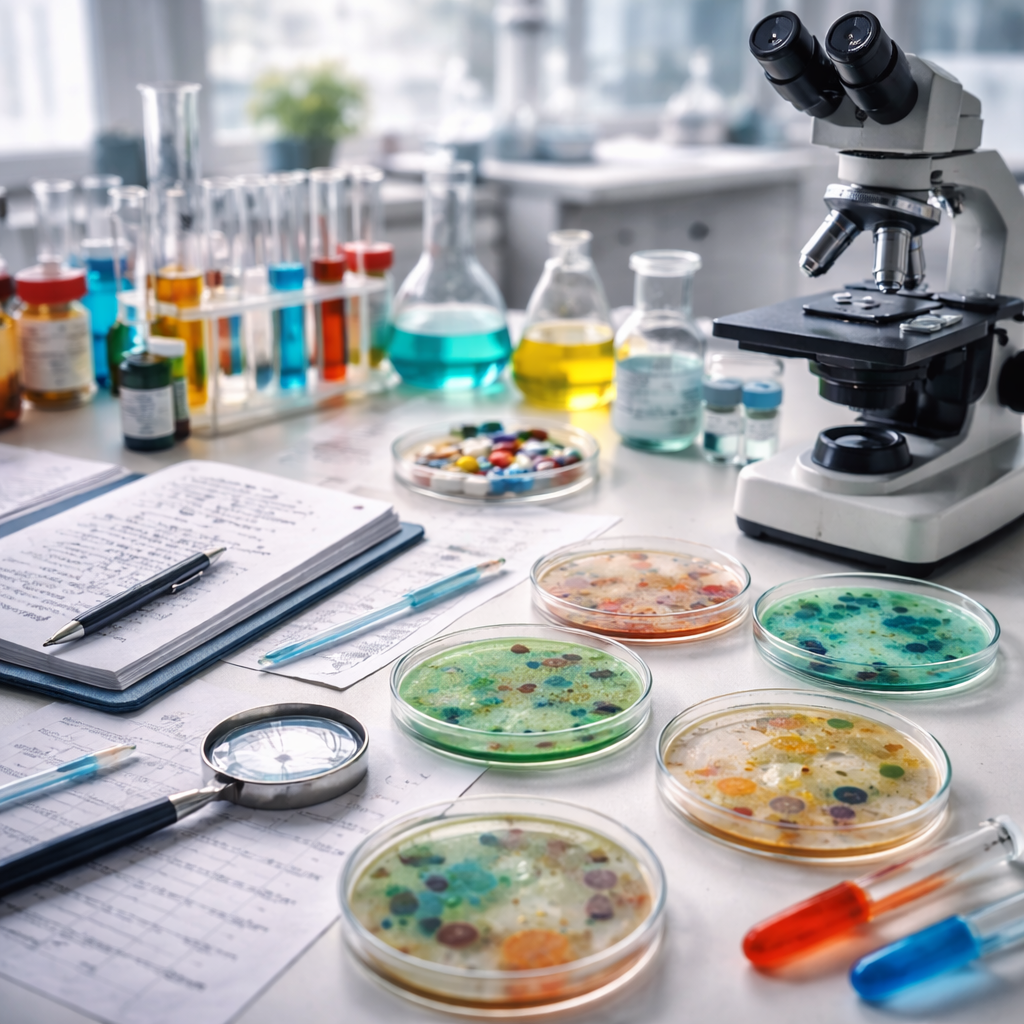
Microbiology, within the Specialized Fields of Biological Sciences, is the study of microorganisms - including bacteria, archaea, fungi, protists, and viruses - and their physiology, genetics, ecology, evolution, and interactions with host organisms and environments. This discipline investigates microbial cell structure, metabolism, growth dynamics, pathogenesis, immune responses, and the molecular mechanisms that govern microbial behavior. It encompasses major subfields such as bacteriology, virology, mycology, parasitology, and microbial ecology. Microbiology is central to understanding infectious disease, nutrient cycling, biotechnology, industrial fermentation, environmental remediation, and the microbiomes that influence plant, animal, and human health. Through microscopy, culturing techniques, genomic sequencing, biochemical assays, and systems-biology approaches, microbiology provides critical insights into organisms that shape global ecosystems, drive biogeochemical processes, and form the foundation of numerous industrial and biomedical technologies.
Within the methodological framework of the Quantum Dictionary, Microbiology represents a domain where terminology is highly contextual and shaped by organism type, methodological platform, ecological setting, and applied objective. Concepts such as “virulence,” “growth,” “resistance,” “community,” or “infection” collapse into distinct semantic states depending on whether they are used in clinical microbiology, microbial ecology, industrial fermentation, environmental microbiology, or molecular-pathogenesis research. Additional variability arises from differences in laboratory methods, genomic technologies, host–microbe interactions, and regulatory environments governing biosafety and public health. The quantum-semantic architecture encodes each microbiological term as a contextual semantic entity whose meaning resolves according to microbial group, experimental framework, ecological or clinical context, or technological modality. This ensures semantic interoperability with adjacent fields such as genetics, molecular biology, biotechnology, immunology, environmental science, and medicine, while preserving the precision required for diagnostics, research, epidemiology, and industrial applications. By modeling the dynamic interplay among microbial physiology, ecological processes, evolutionary pressures, and applied technologies, the Quantum Dictionary provides a coherent and adaptive lexicon aligned with the complexity and foundational importance of Microbiology.