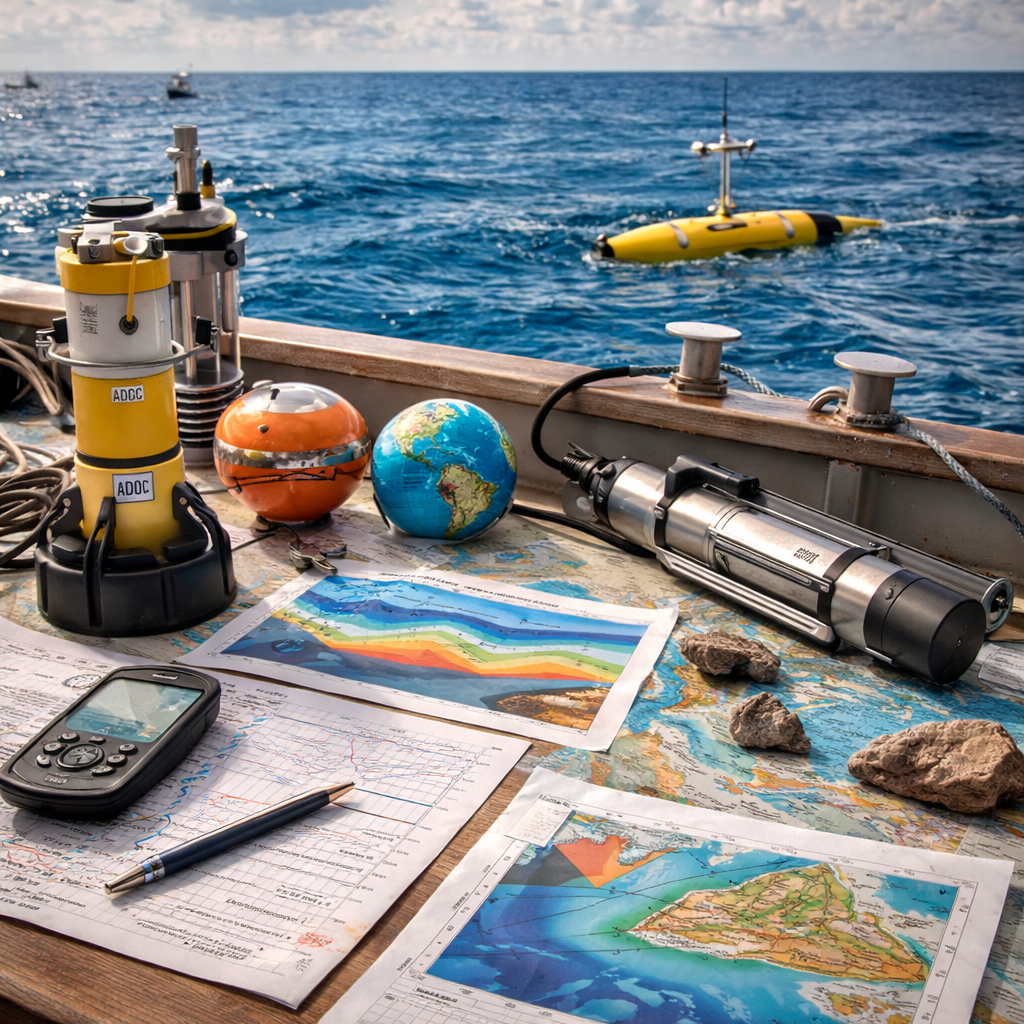
Physical Oceanography, within Oceanography of Earth & Environmental Sciences, is the discipline that investigates the physical properties, dynamics, and large-scale circulation of the world’s oceans. It examines how temperature, salinity, density, pressure, and velocity fields shape ocean structure and movement, and how these processes interact with atmospheric forcing, Earth’s rotation, and basin geometry. Core areas include geostrophic and thermohaline circulation, wind-driven currents, Ekman dynamics, waves and tides, mesoscale eddies, boundary-layer processes, stratification and mixing, and air–sea interactions. Physical oceanographers employ observational systems—satellites, Argo floats, current meters, CTD casts, drifters, moored buoys - as well as laboratory experiments, theoretical analysis, and numerical models to quantify circulation patterns, heat and freshwater budgets, and ocean–climate feedbacks. The field plays a central role in understanding global climate regulation, sea-level change, marine ecosystem dynamics, and the physical basis of oceanic variability across timescales from minutes to millennia.
Within the methodological framework of the Quantum Dictionary, Physical Oceanography represents a domain in which terminology is highly contextual, shaped by spatial and temporal scale, depth regime, dynamical process, and observational or analytical method. Concepts such as “stratification,” “circulation,” “turbulence,” “flux,” or “mixing” collapse into distinct semantic states depending on whether they are invoked in large-scale climate modeling, mesoscale eddy analysis, boundary-layer turbulence studies, internal-wave dynamics, or coastal-ocean forecasting. Terminological nuance also varies with measurement platforms - satellite altimetry, acoustic Doppler current profiling, CTD profiling, autonomous gliders - and with theoretical frameworks such as geostrophic balance, quasigeostrophic theory, or turbulence parameterization. Environmental settings (e.g., polar oceans, equatorial upwelling zones, western boundary currents, marginal seas) further modify conceptual interpretation due to unique thermal, dynamical, or topographic constraints. The quantum-semantic architecture encodes each term as a contextual semantic entity whose meaning resolves according to dynamical regime, observational technique, depth structure, or model formulation. This ensures semantic interoperability with adjacent domains including chemical and biological oceanography, climatology, hydrology, and marine geology while preserving definitional rigor crucial for circulation modeling, climate prediction, and operational oceanography. By modeling the interplay among physical forcing, dynamical response, and observational frameworks, the Quantum Dictionary provides a coherent and adaptive lexicon aligned with the complex, multiscale, and climate-critical nature of Physical Oceanography.