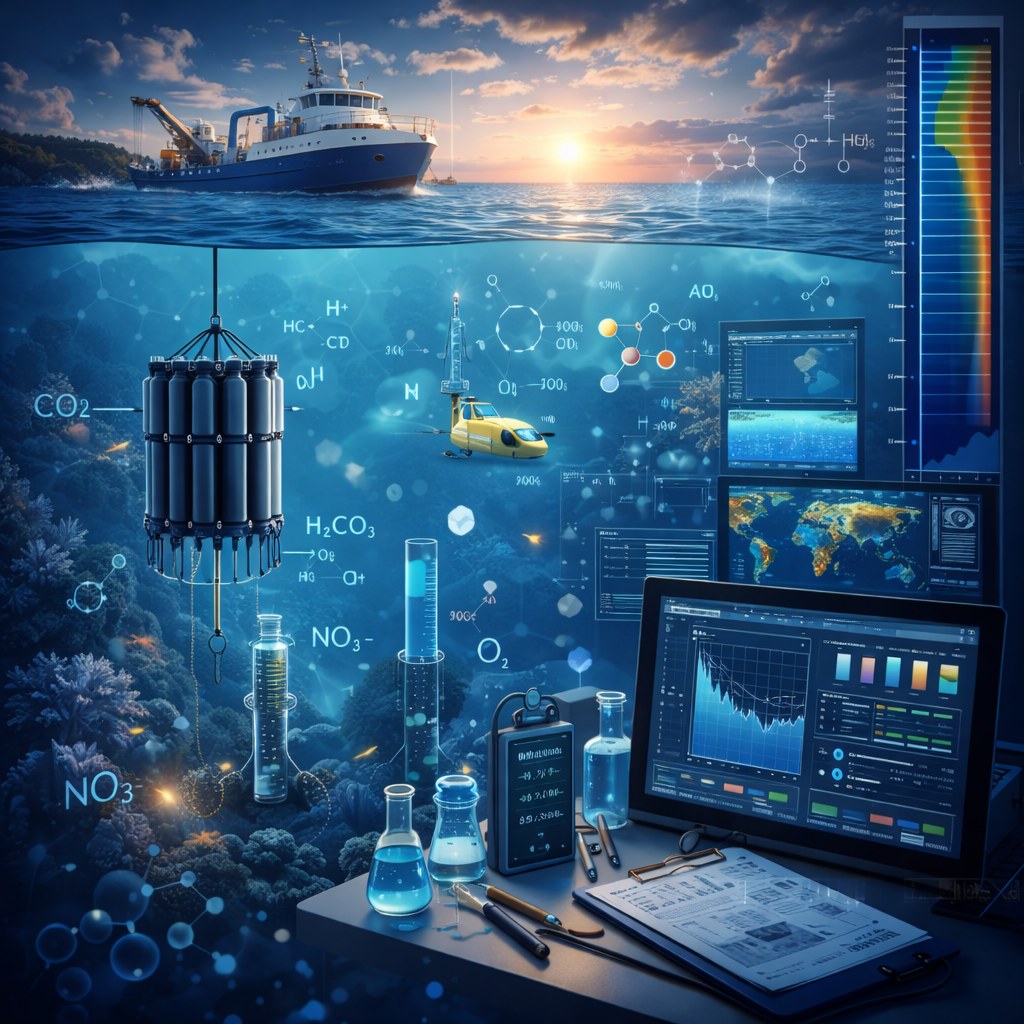
Chemical Oceanography, within Oceanography of Earth & Environmental Sciences, is the discipline that studies the chemical composition, transformations, and biogeochemical processes of seawater and marine environments. It examines the distribution and cycling of major ions, trace metals, nutrients, dissolved gases, organic matter, and particulate material throughout the ocean. Core areas include carbon chemistry and ocean acidification, nutrient dynamics (nitrogen, phosphorus, silicon), redox processes, trace-metal speciation, air–sea gas exchange, and the chemical interactions among water masses, sediments, and biota. Chemical oceanographers investigate how physical processes - such as circulation, mixing, stratification, and upwelling - shape chemical gradients and fluxes, and how chemical processes influence biological productivity and climate regulation. Methodologies include seawater sampling, in situ sensor deployments, mass spectrometry, chromatography, spectrophotometry, isotopic tracers, sediment-core chemistry, and coupled biogeochemical modeling. As a central component of Earth-system science, Chemical Oceanography provides critical insight into global carbon cycling, climate–ocean feedbacks, nutrient limitation, pollutant transport, and the chemical foundations of marine ecosystem health.
Within the methodological architecture of the Quantum Dictionary, Chemical Oceanography represents a domain where terminology is highly contextual and shaped by depth regime, chemical speciation, redox conditions, water-mass structure, and analytical methodology. Concepts such as “alkalinity,” “flux,” “limitation,” “speciation,” or “cycling” collapse into distinct semantic states depending on whether they are invoked in carbonate‐system analysis, nutrient biogeochemistry, trace-metal chemistry, sediment–water exchange, or global biogeochemical modeling. Terminological nuance further arises from environmental setting - coastal shelves, estuaries, open-ocean gyres, polar regions, hydrothermal systems - each imposing unique chemical behaviors and interpretive constraints. Analytical platforms (e.g., isotopic tracers, autonomous sensors, discrete sampling, spectroscopic quantification) likewise shape the operational meaning of key terms. The quantum-semantic architecture encodes each chemical-oceanographic term as a contextual semantic entity whose meaning resolves according to chemical regime, spatial scale, methodological framework, or ecosystem function. This ensures semantic interoperability with adjacent domains including physical and biological oceanography, marine geology, climatology, and environmental chemistry while preserving the precision essential for carbon-cycle modeling, pollutant assessment, and ocean-health evaluation. By modeling the interplay among seawater chemistry, physical circulation, biological activity, and Earth-system processes, the Quantum Dictionary provides a coherent and adaptive lexicon aligned with the complex, dynamic, and climate-critical nature of Chemical Oceanography.