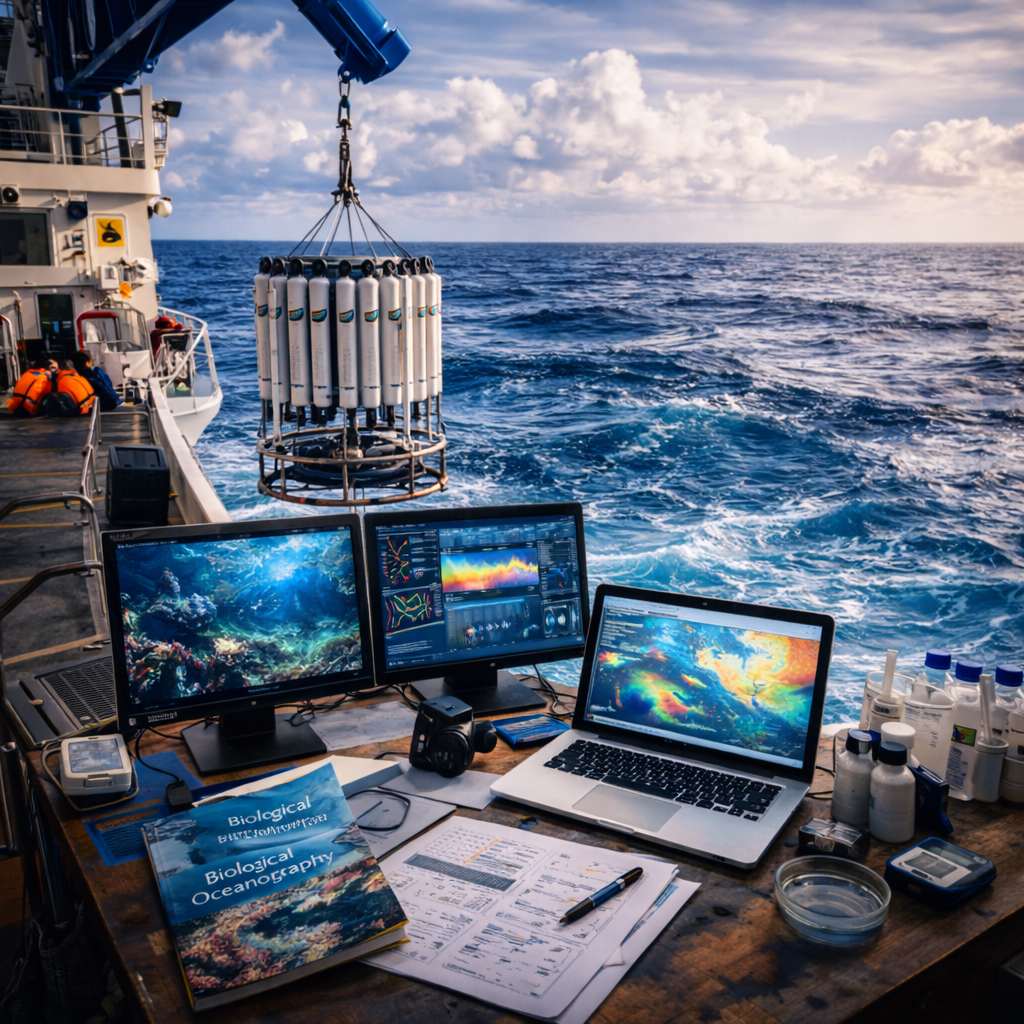
Biological Oceanography, within Oceanography of Earth & Environmental Sciences, is the discipline that investigates the distribution, productivity, physiology, behavior, and ecological interactions of marine organisms in relation to the physical, chemical, and geological properties of the ocean. It focuses on the biological components of marine ecosystems - from microorganisms such as phytoplankton, bacteria, and archaea to zooplankton, nekton, and benthic organisms - and examines how these communities respond to and influence oceanic conditions. Core areas include primary production and photosynthesis in the euphotic zone, nutrient limitation and biogeochemical cycling, trophic dynamics, microbial ecology, population connectivity, life-history strategies, and ecosystem responses to climate variability. Biological oceanographers employ ship-based sampling, autonomous sensors, remote sensing, laboratory cultures, molecular and genomic tools, and coupled physical–biological models to understand patterns of biodiversity, ecosystem function, and biogeochemical fluxes such as carbon export. As a central field in marine science, Biological Oceanography provides essential insight into fisheries productivity, climate–ecosystem feedbacks, ocean health, and the role of marine biota in regulating Earth’s climate system.
Within the methodological framework of the Quantum Dictionary, Biological Oceanography represents a domain where terminology is deeply contextual, shaped by water-column depth, ecological scale, organism type, biochemical process, and observational or analytical method. Concepts such as “productivity,” “biomass,” “community structure,” “flux,” or “resilience” collapse into distinct semantic states depending on whether they are invoked in phytoplankton primary production modeling, microbial loop dynamics, zooplankton grazing studies, benthic–pelagic coupling analyses, or climate-driven ecosystem assessments. Terminological nuance also varies with methodological approaches - flow cytometry, metagenomics, stable-isotope tracing, acoustic surveying, satellite chlorophyll retrieval, or biophysical modeling - and with environmental regimes such as coastal upwelling zones, oligotrophic gyres, polar seas, or deep-sea habitats. The quantum-semantic architecture encodes each term as a contextual semantic entity whose meaning resolves according to biological scale, oceanographic setting, trophic framework, or measurement platform. This ensures semantic interoperability with adjacent domains including physical and chemical oceanography, marine biology, ecology, climatology, and environmental management while preserving the definitional precision essential for biogeochemical modeling, ecosystem assessment, and marine-resource governance. By modeling the interplay among marine organisms, environmental drivers, trophic processes, and ocean-climate interactions, the Quantum Dictionary provides a coherent and adaptive lexicon aligned with the integrative, dynamic, and globally consequential nature of Biological Oceanography.