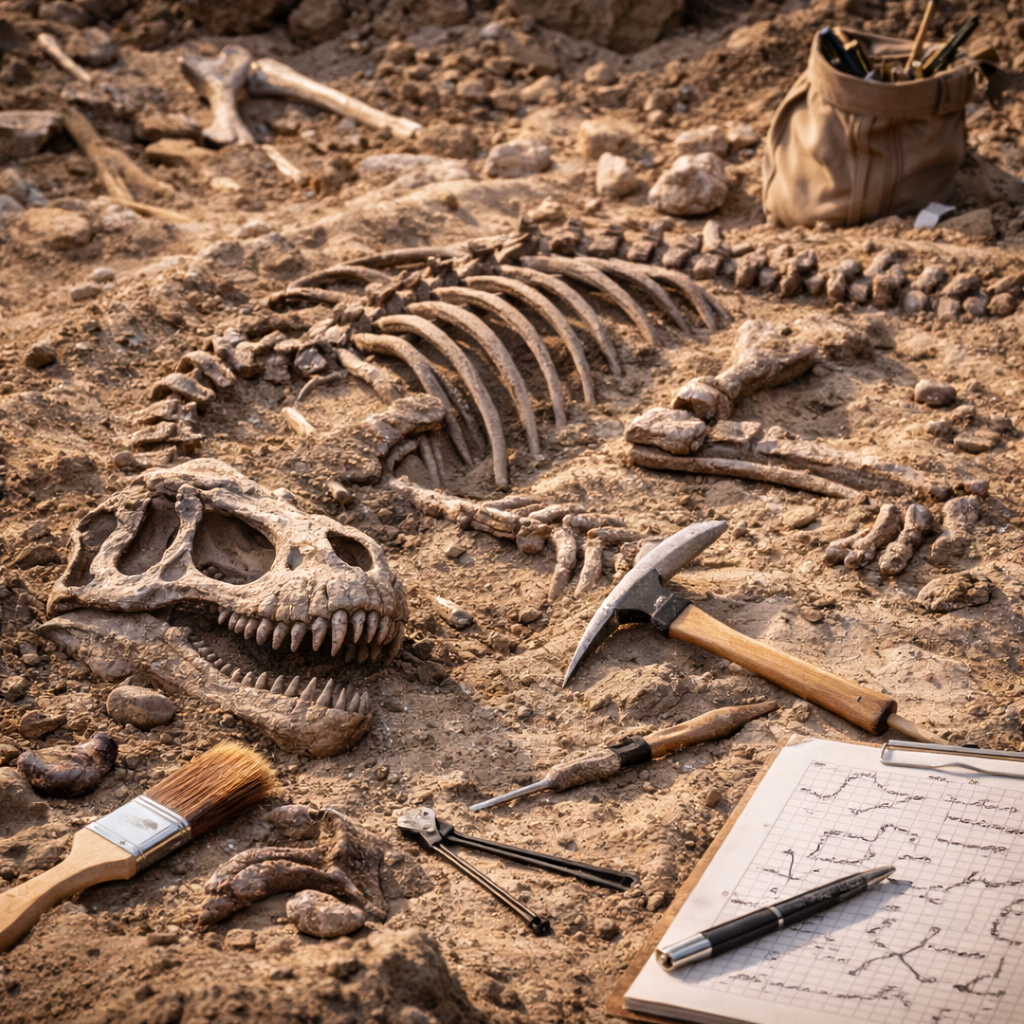
Paleontology, within Geology, is the scientific study of past life on Earth through the analysis of fossils - including body fossils, trace fossils, and molecular or geochemical signatures preserved in rocks. It integrates biological principles with geological context to reconstruct ancient organisms, ecosystems, evolutionary patterns, and environmental conditions. Core areas include taxonomy and systematics of extinct organisms, taphonomy (fossilization processes), biostratigraphy, paleoecology, paleoclimatology, and macroevolutionary dynamics. Paleontologists examine how life has changed over geological time, investigating mass extinctions, radiations, morphological innovations, species interactions, and long-term ecological transitions. Analytical approaches draw on field excavation, sedimentological interpretation, comparative anatomy, microscopy, radiometric dating, isotopic geochemistry, computed tomography, and quantitative modeling. By situating biological remains within their stratigraphic and environmental frameworks, Paleontology provides indispensable insight into Earth’s evolutionary history, the development of biodiversity, environmental change across deep time, and the coevolution of life and planetary systems.
Within the methodological framework of the Quantum Dictionary, Paleontology represents a domain where terminology is highly contextual, influenced by fossil type, depositional environment, temporal resolution, analytical method, and evolutionary framework. Concepts such as “species,” “assemblage,” “morphology,” “extinction,” or “diversity” collapse into distinct semantic states depending on whether they are used in biostratigraphic correlation, phylogenetic reconstruction, paleoecological inference, morphometric analysis, or macroevolutionary modeling. The meanings of key terms further vary with taphonomic conditions, preservation biases, sedimentological processes, and chronological uncertainties that shape the interpretation of fossil records. The quantum-semantic architecture encodes each paleontological term as a contextual semantic entity whose meaning resolves according to geological timescale, fossil completeness, methodological approach, or theoretical paradigm. This ensures semantic interoperability with adjacent fields including evolutionary biology, sedimentology, climatology, ecology, and geochemistry, while preserving the definitional rigor essential for reconstructing deep-time biological patterns and environmental contexts. By modeling the interplay among fossil preservation, geological processes, evolutionary mechanisms, and analytical frameworks, the Quantum Dictionary provides a coherent and adaptive lexicon aligned with the integrative, historical, and deeply interpretive nature of Paleontology.