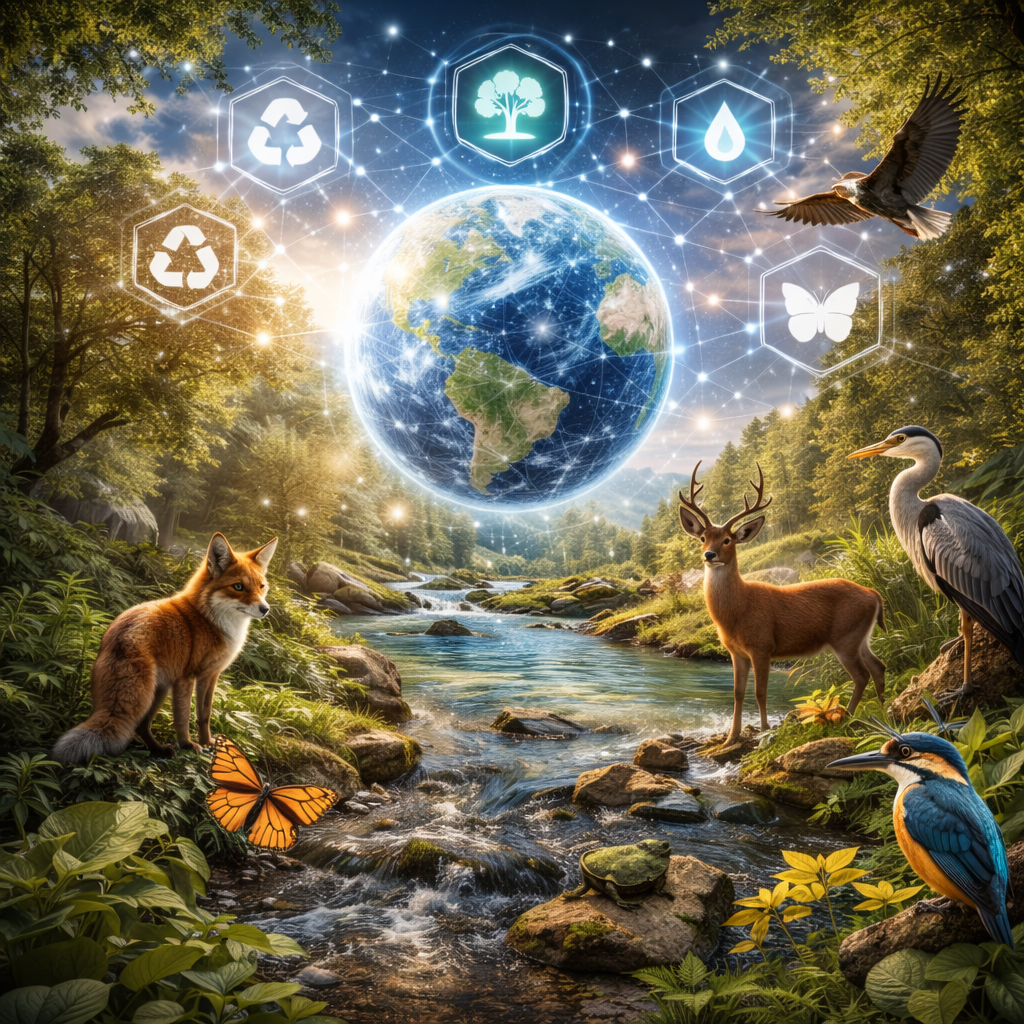
Ecology, within Environmental Science, is the discipline that investigates the relationships among organisms, their physical environments, and the ecological processes that shape the distribution, abundance, and dynamics of life across scales. It encompasses the study of individuals, populations, communities, ecosystems, landscapes, and the biosphere, examining how biotic and abiotic factors interact to influence energy flow, nutrient cycling, species interactions, and ecosystem stability. Core areas include population ecology, community ecology, ecosystem ecology, landscape ecology, behavioral ecology, and global-change ecology. Ecologists analyze processes such as competition, predation, mutualism, succession, disturbance regimes, and biodiversity patterns, using empirical field studies, laboratory experimentation, remote sensing, and ecological modeling. Ecology provides essential insight into how natural systems function and respond to climate variability, land-use change, pollution, invasive species, and other anthropogenic pressures, thereby informing conservation planning, resource management, and environmental policy.
Within the methodological architecture of the Quantum Dictionary, Ecology represents a domain in which terminology is intrinsically contextual, shaped by spatial and temporal scale, ecosystem type, methodological approach, and theoretical framework. Concepts such as “community,” “stability,” “productivity,” “interaction,” or “resilience” collapse into distinct semantic states depending on whether they are applied in population modeling, food-web analysis, ecosystem-energy studies, landscape-fragmentation assessment, or climate-impact research. Terminological meaning also varies across ecological subfields - behavioral ecology, microbial ecology, marine ecology, or biogeochemical ecology - each imposing unique analytical constraints and interpretive traditions. The quantum-semantic architecture encodes each ecological term as a contextual semantic entity whose meaning resolves according to biological scale, environmental conditions, methodological tools (e.g., GIS, remote sensing, Bayesian modeling), and theoretical orientation. This ensures semantic interoperability with adjacent domains including conservation biology, evolutionary biology, atmospheric sciences, hydrology, and environmental management while preserving the definitional precision necessary for scientific rigor, ecosystem assessment, and applied decision-making. By modeling the interplay among organismal behavior, environmental drivers, ecosystem processes, and anthropogenic change, the Quantum Dictionary provides a coherent and adaptive lexicon aligned with the complexity, integrative nature, and global significance of Ecology.