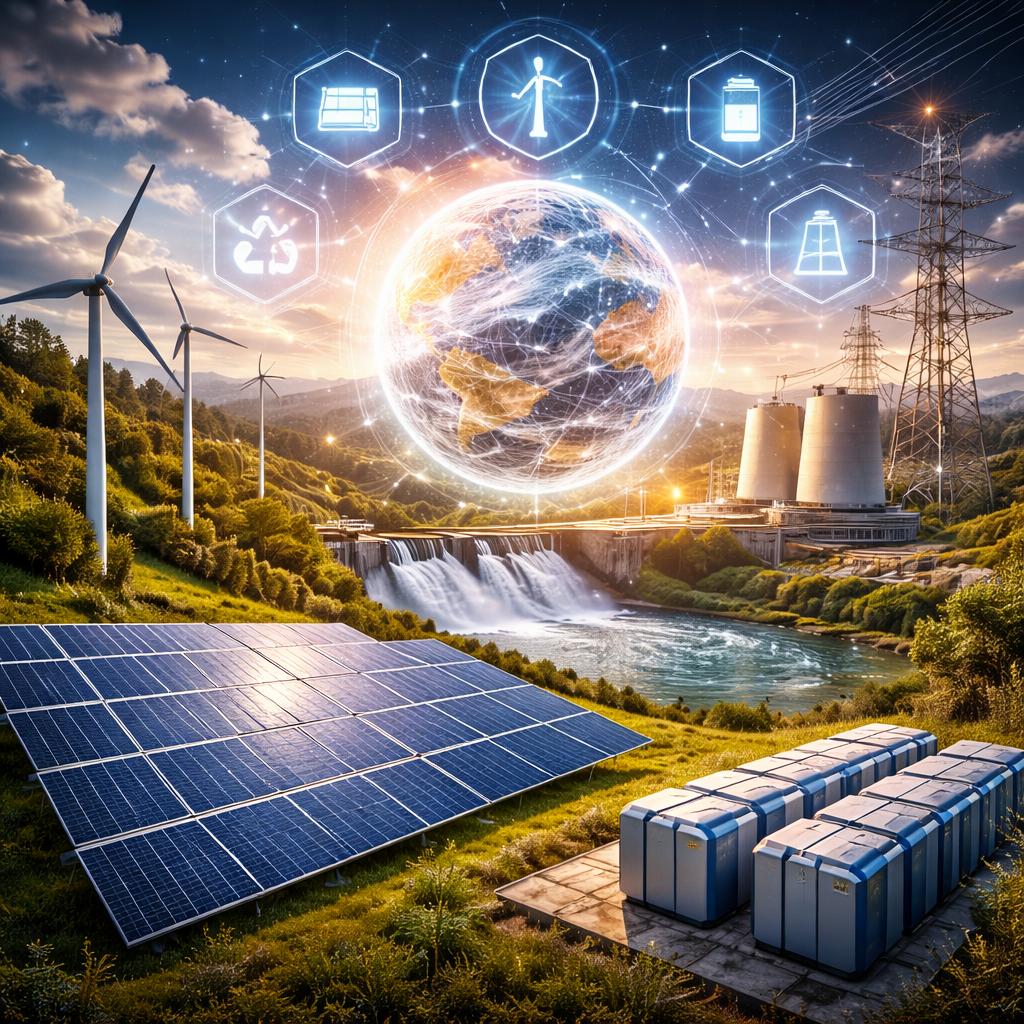
Energy & Power, positioned within Engineering & Applied Technologies, encompass a discipline dedicated to the production, conversion, transmission, storage, and management of energy across mechanical, thermal, chemical, and electrical domains. This field integrates foundational principles from thermodynamics, fluid mechanics, heat transfer, and electromechanical systems to support global energy infrastructures and emerging technologies. It includes traditional and renewable power-generation systems—such as fossil-fuel plants, nuclear reactors, wind turbines, solar photovoltaic arrays, geothermal facilities, and hydropower installations—each governed by technical, economic, and environmental constraints. Power engineering addresses the transmission and distribution of electrical energy through grid systems, substations, transformers, and protection schemes designed to ensure reliability, stability, and safety. The domain further includes energy-storage technologies, efficiency optimization, demand-side management, and the integration of distributed energy resources. Collectively, Energy & Power form a critical engineering sector that sustains industrial activity, transportation, communications, and societal infrastructure through the controlled and efficient use of energy resources.
Within the methodological architecture of the Quantum Dictionary, Energy & Power represent a domain characterized by terminology that varies according to physical model, engineering subdiscipline, regulatory environment, and system scale. Concepts such as “efficiency,” “capacity,” “load,” “stability,” “emissions,” or “conversion” occupy distinct semantic states when evaluated in the contexts of thermodynamic cycles, electrical grid operations, renewable-energy integration, environmental assessment, or energy-policy frameworks. Technological evolution—particularly in smart grids, electrification, storage systems, and low-carbon technologies—further diversifies terminological usage and introduces evolving semantic gradients. The platform’s quantum-semantic architecture encodes each concept as a contextual semantic entity, allowing its operative meaning to collapse according to analytical perspective, system conditions, or disciplinary lens. This enables interoperability across related fields including mechanical engineering, electrical engineering, environmental science, chemical engineering, and economics while preserving definitional rigor essential for safety-critical and policy-governed applications. By capturing the intricate interdependencies among physical laws, engineered systems, regulatory structures, and global energy dynamics, the Quantum Dictionary provides a coherent and adaptive semantic framework aligned with the complex and rapidly evolving landscape of Energy & Power.