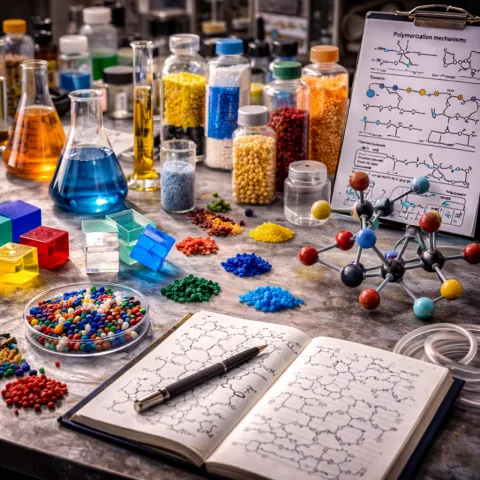
Branches, within the Chemistry hierarchy of the Natural & Formal Sciences, refer to the core disciplinary divisions that define the theoretical, structural, and mechanistic foundations of chemical science. These branches—Biochemistry, Inorganic Chemistry, Organic Chemistry, and Polymer Chemistry—represent distinct yet deeply interconnected areas through which the behavior, composition, and transformations of matter are understood. Together, they form the conceptual architecture underlying both pure and applied chemistry, providing the theoretical basis for advanced research, industrial processes, and interdisciplinary scientific exploration.
Biochemistry examines the chemical processes that occur within and between living organisms, focusing on biomolecules such as proteins, nucleic acids, lipids, and carbohydrates. It elucidates metabolic pathways, enzyme mechanisms, cellular regulation, and molecular communication, serving as a bridge between chemical principles and biological function. Inorganic Chemistry investigates the properties and reactivity of inorganic compounds, including metals, minerals, coordination complexes, and organometallics. It plays a foundational role in catalysis, materials science, energy systems, and environmental chemistry. Organic Chemistry centers on carbon-based molecules, exploring their structures, mechanisms, synthesis, and reactivity. It supports pharmaceuticals, polymers, natural products, and countless industrial and biological applications. Polymer Chemistry focuses on macromolecular systems - synthetic and natural - investigating polymerization mechanisms, molecular architecture, material properties, and applications in plastics, biomaterials, coatings, and advanced functional materials. Together, these branches map the universe of chemical matter from the molecular to the macromolecular, from living systems to engineered materials.
Within the methodological framework of the Quantum Dictionary, the Branches of Chemistry represent a domain where terminology is inherently contextual, shaped by molecular framework, bonding theory, analytical technique, and disciplinary conventions. Concepts such as “reactivity,” “stability,” “coordination,” “mechanism,” “structure,” or “function” collapse into distinct semantic states depending on whether they are applied within biochemical pathways, inorganic complexes, organic reaction networks, or polymer systems. Further variation emerges from differences in synthetic strategies, spectroscopic methods, computational models, and material-performance criteria. The platform’s quantum-semantic architecture encodes each chemical concept as a contextual semantic entity whose meaning resolves according to molecular domain, experimental method, structural framework, or functional objective. This ensures semantic interoperability across all branches of chemistry—while preserving the definitional rigor essential for research, material development, chemical manufacturing, and interdisciplinary innovation. By modeling the interplay among chemical structure, reactivity, biological relevance, and material functionality, the Quantum Dictionary provides a coherent and adaptive lexicon aligned with the rich and multifaceted nature of Chemistry’s Branches.